

Context
Taylor Tax Prep is a tax-services and notary company that also helps small businesses get off the ground — incorporation, formation, and the range of services that come with it. The business grew faster than expected, bringing in far more clients than its systems were built to handle. To keep up, it had stitched together a different tool for every function: Calendly for scheduling, one provider for the website, a separate company for content management, a social media scheduler, a mail service for automated email, and more.
The challenge
Each tool solved one problem and created another. Client data and interactions were spread across platforms that didn't talk to each other, so managing a growing customer base meant jumping between systems and reconciling information by hand. The sprawl was its own tax — more logins, more moving parts, and more that could fall through the cracks as volume climbed. It was also expensive: a stack of separate subscriptions, several overlapping in what they did, quietly accumulating cost without any single place to actually run the business from.
Our approach
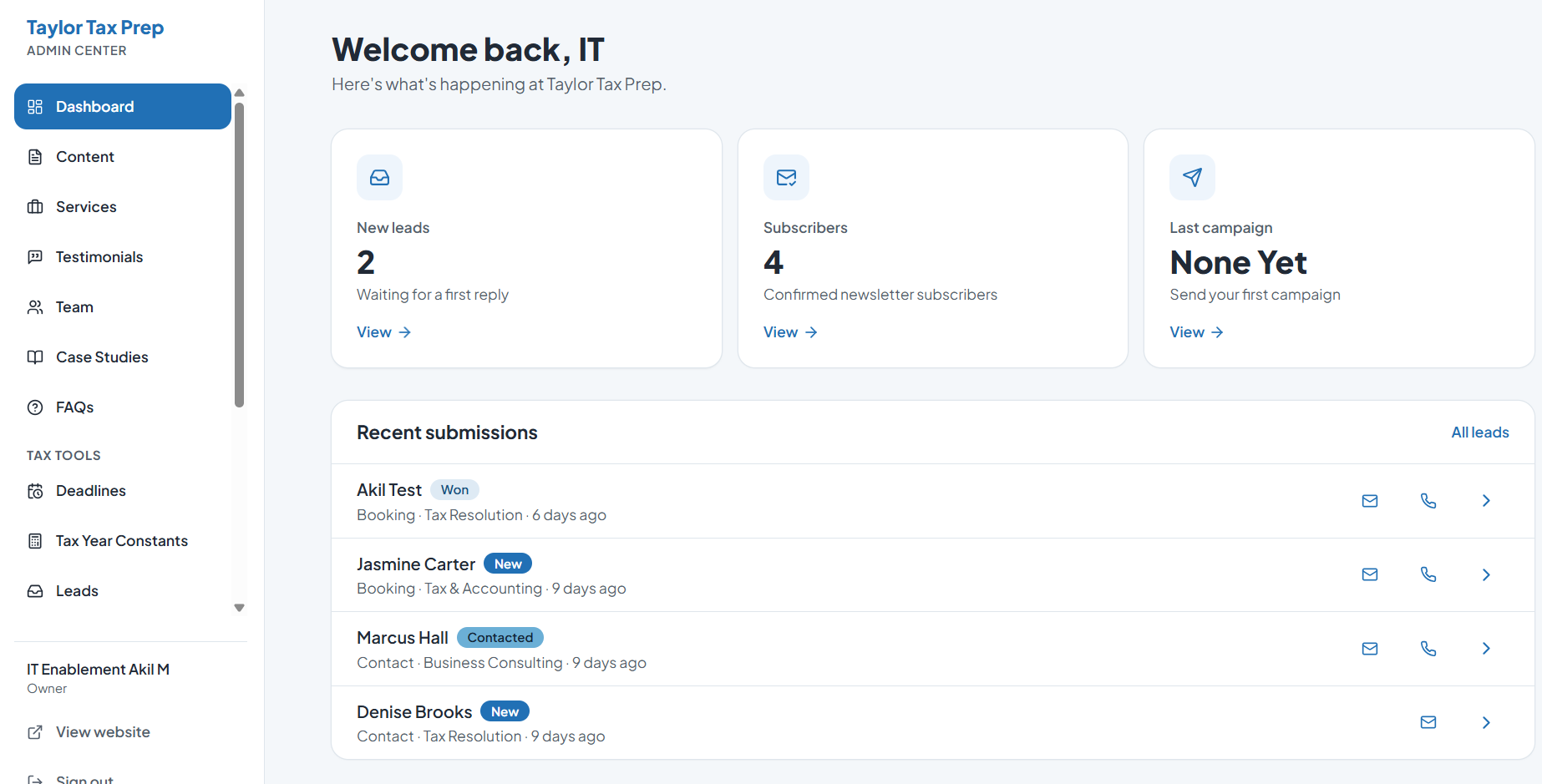
ITES first built Taylor Tax Prep a new website. When the business came back needing a way to pull its scattered systems together, ITES turned that website into a custom-built web application designed to be the single place the company operates from. The webapp replaced the patchwork of external tools with one integrated system: a CRM to hold client data and interactions, a built-in messaging platform, a content-management system, email automation, and a social media integrator — all under one roof. Scheduling, previously handled through a standalone tool, now connects directly to Google Calendar. Consolidating these functions into a single application meant the separate subscriptions behind them were no longer needed.
What the team experienced
Replacing the scattered stack with one system changed how the business runs day to day — client data, communication, content, and scheduling now live in one place instead of across half a dozen disconnected tools, so a growing client base no longer means growing sprawl. Retiring the redundant subscriptions that consolidation made unnecessary also brought the company's tooling costs down. What had been a collection of platforms each solving a single problem became one application the business could actually operate from as it continued to grow.
Related services
Website/WebApp Design
Professional, performance-focused websites designed to represent your brand and convert the right visitors.
Workflow & AI Automation
Replace manual, repetitive processes with structured automated workflows — and, where it makes practical sense, scope AI-assisted steps into them.
Custom Apps
Custom web apps and internal operations platforms built around how your team works — including modern replacements for aging legacy systems.
IT Support as a Service
Responsive, relationship-based IT support for teams that need reliable help without the overhead of an in-house IT department.
Working through something similar?
A free discovery call is the right first step. We'll ask the right questions and tell you honestly what we'd recommend.